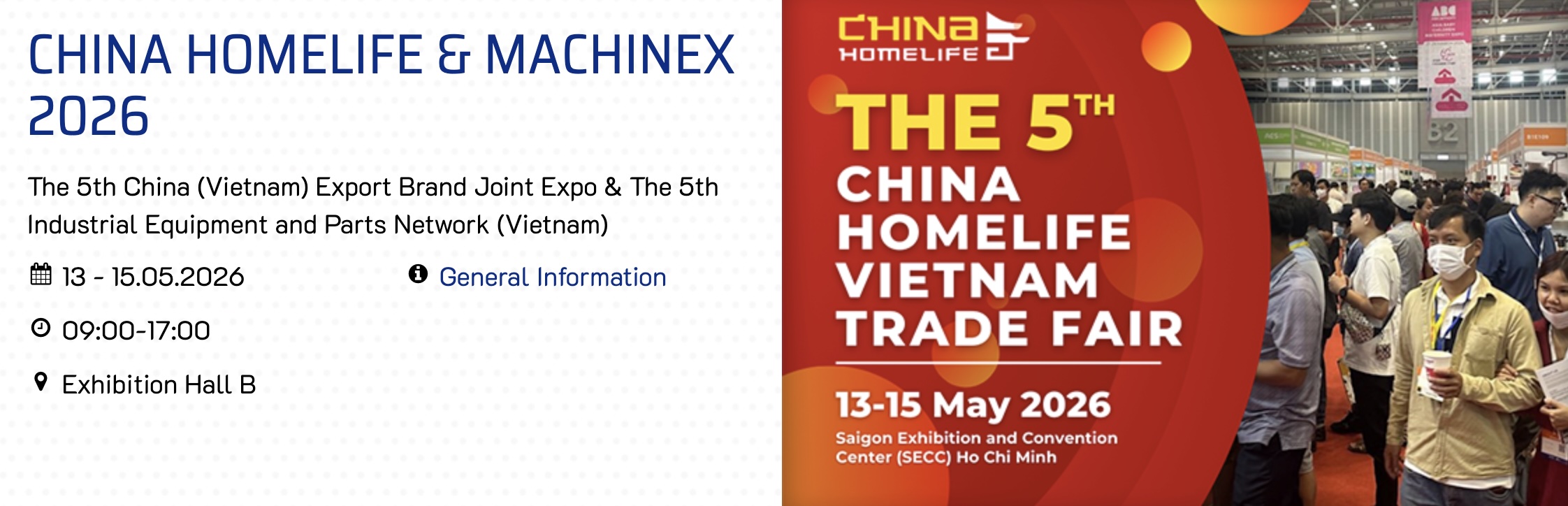
A few weeks earlier I had visited a similar fair for textiles and related products with many suppliers from China. I was impressed that they had shiped entire fabrication machines to the exhibition site to show them in production. What awaits me this time?
Advertisement on the page of the SECC
Yes, just wanted to stop by shortly, but then Pickleball was canceled. And there was so much to investigate! It were actually 6 exhibitions in 3 halls:
One thing I was interested was coffee makers, and one machine served free coffee to the visitors – indicated by the long line there. But that’s just one example.
There are also solar panels, MPPT solar chargers, battery blocks (in 2025 the price/kWh has fallen by 40%), inverter (we needed one for Simon in the Phillipines, Malungon)
Some let you have a look inside to be sure of the quality. I made contact on WeChat and got a new supplier for our KH door from Taiwan with production side in northern China.
But there were even stranger supplies. Here a short list:
AMD graphics card RX580 with 8GB RAM (released 2017 – 9 years ago!!)
UHF 640-690 MHz dual wireless microphone from Sertong (Guangzhou Sertong Electronics Technology Co., Ltd., est. 2004)
OEM producer for portable batteries as off-grid power or energy storage for solar, that also provides services to Xiaomi, Haier and BYD
Robotphoenix with a 4D package robot on display. They also provide educational robots, and send me their catalog (No. 477 Hongxing Road, Xiaoshan Economic Development Zone, Hangzhou, Zhejiang, China)
Gas separation plant for N, O, Ar and liquid nitrogen
The last one was wild. I did not take a picture of their model from a gas separation plant to produce Nitrogon, Oxygen or Argon. I could even have taken it with me for educational purposes. Back in 2007 I needed liquid nitrogen to cool my Helium lamp to produce VUV (vacuum ultra violet) light, similar to EUV (extreme ultra violet) light used by ASML for lithography. But at the Humboldt university we bought the liquified gas instead of producing it ourselves. How much would it cost to produce it yourself?
Gas separation plant
The main obstacle is actually the energy cost. Main application in China is nitrogen gas. I think it is for food purposes because of its inert nature. Here are the prices:
Nitrogen 0.2 kWh per cubic meter
Oxygen 0,5 kWh per cubic meter
Liquid nitrogen 1.0 kWh per cubic meter
If you don’t need it in liquid form, the gas is 5x cheaper. I forgot the price for Argon (0.9% of our athmosphere) that we used for TIG welding at SSIS. I still remember my early attempts on the 3mm aluminum cube. Good times! Now I’m even more motivated to visit China in summer.
Our course is studying the Vietnamese language and culture. Both are strongly influenced by the Chinese neighbor and its language(s) and culture(s). With 4 Chinese students in our group it was fitting to visit the anual Lễ Hội Ẩm Thực Triều Châu (Teochew Food Festival, celebrated from the 16th to the 27th day of the First Lunar Month – March 4 to March 15, 2026) at the Hội Quán Nghĩa An (Nghĩa An Assembly Hall). There is so much to learn about culture and history here!
I could start with the background, since it looks very much like a temple. And a part of this Hội Quán (會館 – community hub) serves as temple, but also as a town hall, a mutual aid society, a commercial network hub, and a place of ancestral worship for immigrants adapting to life in Vietnam.
The specific Chinese group settled here are from Chaozhou (Chinese: 潮州, alternatively Chiuchow, Chaochow or Teochew) in the Teoswa region of east Guangdong, China.
The Food Festival
This festival has it’s own Wikipedia page, but currently only in Vietnamese: Hội quán Nghĩa An. As mentioned above it is held at the end of the first lunar month. It is famous for …
And we tried even more food:
One memorable part is.
Cultural importance
This community hall and the food festival were considered important enough for the Vietnamese culture that it got official recognition and protection. Here is a plate inside the community hall:
The text reads “DI SẢN VĂN HÓA PHI VÂT THỂ QUỐC GIA TẬP QUÁN XÃ HỘI VÀ TÍN NGƯỠNG TẾT NGUYÊN TIÊU CỦA NGƯỜI HOA TP. HCM” which translates to “National Intangible Cultural Heritage: Social Customs and Beliefs of the Lantern Festival (Tết Nguyên Tiêu) of the Chinese Community in Ho Chi Minh City”.
Here is an official list of such recognitions in Vietnam, starting 2012 and now having already 485 entrances: Danh mục Di sản văn hóa phi vật thể quốc gia (List of National Intangible Cultural Heritage).
Since May 16th, 2024, I try to study at the Su Pham university. The requirement in 2024 was to have at least 15 students to get this course started, even though it was intended for 20 students. By June 17th I had submitted my application, but still had to wait for a response in September, when the new semester starts
September 2024 – not enough students
After Independence Day of Vietnam (September 2nd) I finally got an answer on September 5th: We are only 7 students, far from the required 15 students. So this year the course Ngành Tiếng Việt và Văn Hoá Việt Nam will not start. Maybe after TET 2025?
In January 2025 we indeed got an email, but it was only directed to 5 people. The course will not start in the summer semester, so we will have to wait for the winter semester in September 2025.
July 2025 – Hope from Dr. Tâm
I had already contacted Mrs. Tâm on March 11th, and we had a short phone converstion. She wanted to organize study sessions over zoom, but got no permission from administration.
A renewed conversation on July 7th from Núi Dinh lead to a personal meeting at the Su Pham university on Junly 8th. And this gave me new hope, the requirements by the administration are lowered to just 10 people! I prepared the documents.
After the health check on July 25th I finally submitted all documents on July 30th. With just one day left until the deadline for any application it is frightening to know that we have only 3 applicants so far!
September 2025 – we are at go!
My inquiry on September 3rd lead to the responso to please wait a little longer. So I visited on September 15th, and got a great message: The course will start! At the end of the week, on Friday September 19th, I got an email with the now 4 students that would start this bachelor course in the K51 kohort. It’s the 51st year since the university was founded in 1975. More history would follow in December. But first, the enrollement with 400 other students on September 21st:
Yes, when they talk about foreign students, they do look at me. Even though one other student is present, but since he is from China, he looks to Asian to stick out. The two other students from China and Korea are not yet in Vietnam.
October 2025 – Three more students from Laos and China
My student numbers is 51.01.615.002. The 51 stands for 51st kohort, 01 for regular student (not doctorate or higher), 615 for my course at the foreign languages faculty and I’m the second student. By the end of September we all payed, and I have to spent 2 weeks in Cambodia to get my visa. The application process at the immigration office in Saigon can’t be started unless I’m outside Vietnam, so I drive to Cambodia on October 7th and the application is submitted on October 8th.
On October 16th my invitation letter is finally there! You can get the visa at the embassy in Phnom Penh on this very day, but with some extra fee of 205 USD. If you wait 3 working days (until Monday next week, October 20th) it is only 160 days. And if you can wait 5 working days, it’s only 145 USD. Compared to my expenses in PP it makes sense to wait the extra days until Monday. And I get a lot of stuff done in the coffee shops in this time.
We officially start on October 27th, 5 weeks after the welcome ceremony on September 21st. But I’m in Hanoi for a wedding, and two more students are still in China. So we meet virtually on Google Meet – that does not work in China. We figure out, that Zoom does not work either. But Dr. Tâm is welcoming us all and giving us the important information we need.
Two weeks later, on November 10th, I’m finally in class in person! Time to learn Vietnamese, with 7 weeks delay. To catch up will take some time. But we’re still not complete!
One week later our department postpones the celebration of Teachers day from Thursday, November 20th to Tuesday, November 18th. Now we have at least a group picture of 6 of us in the auditorium with 600 Vietnamese students:
6 students on November 18th in the auditorium
Read more about it at Teacher day in Vietnam. One day later (November 19th) we’re finally complete!
So what is the history of course 615 – Ngành Tiếng Việt và Văn hoá Việt Nam? A conversation with Mrs. Tâm on Friday, December 19th, gives me further insight.
Course 615 in the past
When we open our book 1 and 2, we see that the printing was ordered 1000 copies of book 1 in 2016 (with two different editions in our class) and 500 copies of book 2 in 2015. This is at least the second iteration, only book 4 should still be very old.
In the years prior to Covid-19 many students from Korea attended the university to learn Vietnamese. Their parents worked at companies in Saigon, and large classes of up to 35 students learned more about the Vietnamese language and culture of Vietnam.
Another group signing up for university were students from Afrika. One student was also signing up his sister, father, mother and aunt. For about 1000 USD each got a one year multi entry visa for Vietnam that would otherwise be more expensive or not attainable. But the immigration office had already started to crack down on this practice and required the students to actually show up to class, not just on day one. This “loophole” was already fixed in the 2010s.
But with all the restrictions during the pandemic time the class K45 (2019-2023) had to start studying online in 2020. With the uncertainty K46 was not started in 2020. While the situation was rather safe in Vietnam, international travel would not have foreigners enter the country, and K45 had already returned home.
In early 2021 Saigon was severly affected by the Omicron variant. And while vaccinations were slowly rolling out in summer, the city went into lockdown from June to August 2021. Many were stuck in Phu Quoc, and three months of only virtual activity meant that there was also no K47.
The numbers then never returned to normal. Currently K48 and K49 have only 2 students, so these 4 students learn together now.
Name of the Class
Years of Study
Number of Students
Minimum number of St.
K45
2019-2023
35
K46
2020-2024
–
K47
2021-2025
–
K48
2022-2026
2
?
K49
2023-2027
2
?
K50
2024-2028
0
15
K51
2025-2029
7
10
Yet without students the ministry of education would eventually delete course 615. This assessment is done every 3 years. Two very low student years and one year without students meant to lower the requirement to just 10 students for K51 – and even that could not be met. Well, we are at least 7 students, and for the second semester we might get some exchange students from Taiwan. So far this course is still alive. Let’s see what happens next year. And if we can finish our bachelor.
It’s puzzling to realize how much time I spent to get an education. By 2025 I used 12 years of my life to get professional training, in addition to my 10 years of regular school attendance. That’s right, I don’t have a high school diploma (Abitur in Germany). But I taught high school kids and helped them improve their grades.
Kommunikationselektroniker – 3 years
My first professional education is from vocational training at the Deutsche Telekom AG, Niederlassung Potsdam on the Telegrafenberg. It usually requires 3.5 years, but I could shorten it with 4 other students to just 3 years. The official description is Kommunikationseletroniker Fachrichtung Fernmeldetechnik (communication electronics technician, specialized in telecommunication).
Diplom-Physiker – 7.5 years
I started to study physics at the Humboldt Universität zu Berlin in 2000. This is before the bachelor and masters degree were introduced in Europe following the Bologna process. The diploma I received is now considered equal to a masters degree.
The regular study time (Regelstudienzeit) for physiks is 5 years. But I spent 2 semester at the MSU – Moscow State University (МГУ Моско́вский госуда́рственный университе́т и́мени М. В. Ломоно́сова) in Russia. And I invested 1.5 years into the investigation of HgCdTe Narrow-Gap Semiconductors at the HU and BESSY (Elektronenspeicherring-Gesellschaft für Synchrotronstrahlung mbH). The work is reflected in my diploma thesis “Elektronische Eigenschaften von CdxHg1-xTe mit 0.07 < x < 0.4” (here a link to the document on my personal university homepage).
The diploma system does not have a major and minor part. You are only required to study an additional subject for one semester. I chose physical chemistry (Physikalische Chemie) by Prof. Rademann in 2001 with a practice (many experiments and lab reports) over the summer break. This was really fun!
This degree allowed me to teach Math, Physics, Chemistry and Computer Science at public schools in Germany. In 2012 I finally decided to officially become a teacher and get a teaching license.
Oberstufenlehrer für Mathematik und Physik im Niedersächsischen Schuldienst – 1.5 years
Teachers in Germany study for a master of education at universities. But that is only the first step, therefore called Erstes Staatsexamen (first state exam). To qualify as a teacher you also need to pass your Zweites Staatsexamen (second state exam), which usually requires an additional 2 year training period called Referendariat with a teaching obligation of 10 hours per week and lectures at a specialized institute.
I started my ‘Referendariat’ at the Studienseminar Stade in Lower Saxony. To save costs the state had reduced the training time to 1.5 years. While living in Hofkoh, I was travelling to the Studienseminar Lehramt an Gymnasien (45 kilometers), continued to the Gymnasium Warstade in Hemmoor (another 29 kilometers) and after a day of work with frequent visits to my lectures traveled the 56 kilometers back home on most days of the week. It was a stressful time 2012/08 – 2014/01.
Above the start on August 1st, 2012; Mathe Leistungskurs 12 in Hemmoor 2013 and finally the graduation on January 19th, 2014.
In summer 2015 at the Didacta I realized that there are more then 200 International German Schools around the world! It took a while to make up my mind and collect information, but in February 2016 I started applying for several schools around the globe. Here is the list until April 2016:
Taiwan, Taipei
China, Shanghai Pudong
Egypt, Hurghada
India, Mumbai
Vietnam, Saigon or Ho Chi Minh City
Indonesia, Jakarta
Turkey (now Türkiye), Ankara
Russia, Moscow
I added my resume to the database. Offers from Belgium and Mexico reached me by email.
Teaching in the English language – 5 years
My teaching degree brought me to Saigon in Vietnam, but I only taught for 1 year in German. After that I worked 3 years for the American International School Vietnam and 2 years for the Saigon South International School. The topics span a variety of subjects and include the American curriculum, IB Diploma Program and AP Advanced Placement. For the IB and AP I received special training. Here is a list:
IB Physics HL/SL (training in Jakarta)
Chemistry
Integrated Science 9/10 (biology, chemistry and physics)
MYP Design (training in Bangkok)
AP Physics A (training in Sacramento)
High School Math
AP CSP Computer Science Principles (training in Baltimore)
Live Science
Advanced Automation
From a certain perspective I was successful with my teaching. In IB Physics at the AISVN we never had an SL student receive 6 points, and only one time in the past a student had received 6 points on HL higher level. No one ever got 7 points. I wanted to change that.
My first 2-year course started in 2018, and the results of 2020 were remarkable. All 15 students passed, both SL and HL. And some students received 6 and 7 points as their IB score, both HL and SL. Usually the best subject at AISVN is IB Vietnamese Literature with an average slightly above 6 points, and for obvious reasons. But in 2020 the best subject was IB Physics HL with an average of 6.5 IB points! Two students scored 6 points, two students scored 7 points. I am very proud of my students! AISVN was fun, see post on twitter/X:
The work at SSIS was also both challenging and rewarding. In 2022-2023 I supervised 2 ASAs (after school activities): The SSIS Robotics club with VEX V5 and the game developer club Unity Impact. At the end of the year we also absorbed the remaining students of the Girls Code club into our Unity Impact club.
The start for VEX was not easy, since I was completely new to the program. Until the end of 2022 no student could travel, so we could not take the students to the Signature Event in Taipei at the TAS to give them some experience in this competition. But early 2023 we set a new Vietnamese record for 12 attending teams from 5 schools at the Vietnam National Championship 2023 Spin Up.
And for the first time we had a Middle School Team in Vietnam. Now there were 2 spots available to represent Vietnam at the World Championship in Dallas. And I was coaching both winning teams, so I could travel with both teams to the United States:
We had a great time in Dallas. It was a nice experience for the students, they progressed so much in the coming years and returned to Dallas in 2025!
Now it’s time for me to improve my Vietnamese. I have lived in this country for 9 years already!
Ngành Tiếng Việt và Văn hóa Việt Nam – 4 years
I started applying for Ngành Tiếng Việt và Văn hóa Việt Nam (Vietnamese Language and Culture of Vietnam) at the Trường Đại học Sư phạm TP. Hồ Chí Minh (Su Pham university) since May 2024, but the requirements to start this course were not met. The course is intended for 20 students, the university requires at least 15 students to sign up. By October 2024 we were only 7 Students.
In 2025 the requirements were lowered to at least 10 students, but by the end of the signup period in July 2025 we were only 3 students. September 1st we were 4, and Ms. Tân could convince the board of directors to start the course anyway. It worked, we are now Tân Sinh Viên Khóa 51 of 7220101. My student ID is 51.01.615.002. The opening ceremony on September 21st was only attended by 2 of our students, the others were still in Korea and China. In October 2025 we have already 7 students! I went to Cambodia for 2 weeks to get my 1-year visa.
It will take 4 years to receive my bachelor degree (bằng cử nhân). The story continues until 2029. By then I will have spent 26 years as a student, almost 50% of my life!
Preparation while in Cambodia
Since October 2023 I enjoyed studying in the cafe on the ground floor of the RS II Guesthouse, Phnom Penh. It was named Coffee TodaY. But for 2 months it is already a new restaurant.
The new restaurant is not yet on Google. And from outside it is difficult to see that you can enter the second floor and the A/C area. I figured it out on October 17th and spent the next 3 days there almost the whole time by myself. I got things done.
Then I tried to publish this place on Google Maps. Let’s start with the name:
SPECIALITY IN PORK – បាយ សាច់ជ្រូកជាតិ
I have no idea how to enter Cambodian or Khmer characters with my keyboard. This was the first challenge. I took a picture and used internet services.
The Wifi is named BAY SACH JRUK CHEAT while Google translate reads bay sach chrouk cheate for បាយ សាច់ជ្រូកជាតិ. Here is the explanation from ChatGPT:
The Khmer phrase បាយ សាច់ជ្រូកជាតិ (bai sach chruk cheat) can be broken down like this:
បាយ (bai) → rice (usually refers to cooked rice or a meal)
ជាតិ (cheat) → national, local, or domestic (as opposed to imported or foreign)
So, បាយ សាច់ជ្រូកជាតិ means: 👉 Rice with local pork or Rice with domestic pork — essentially, “pork and rice made with local meat.”
It could appear on a menu to emphasize that the pork is from Cambodia rather than imported.
So, that’s ChaptGPT. Now it’s on Google Maps too. This is the place I wrote this post. And analyzed more than 1500 bank transactions from my old German bank account of the last 12 years.
And another surpize. The sisters had invited our two German visitors for a boat tour on the Saigon river, and to another dinner afterwards. At 22:00 it was time again to go home, but Jemima asked me “Wollen wir noch einen trinken gehen?”. Not that she (or any of us) would drink alcohol, but we used the next 5 hours to continue our conversation from the day before.
One new thing I learned was the Korean Mango ice cream that seems to be rather popular. But I have never tried it before!
What a surprize to have two sisters from Germany visiting our Vietnamese congregation. Travelling and working all around the world they stopped in Vietnam on their journey to Singapore, China, Korea and Japan. Good that some sisters of our congregation invited them to dinner after the meeting.
At 22:00 the restaurant closed and the other brothers and sisters went home. So I had the chance to continue the conversation in my mother tongue for 3 more hours. A delight after long years of mostly English and Vietnamese.
Kaum zurück aus Phu Quoc wartete schon das nächste Abenteuer. Im Januar konnte ich mich beim HCMCRUN leider nicht mehr für den 10km-Lauf anmelden. Nächste Möglichkeit war der La course du Printemps- The Spring Race 2017 um den Golfplatz hier in HCMC:
Die Strecke geht einmal um den See und dann noch einmal um den ganzen Golfplatz. Siehe folgende Grafik:
In der Zwischenzeit gibt es auch schon ein Video von dem Lauf – mit tollen Luftaufnahmen der herrlichen Strecke:
https://youtu.be/Ao2RXAZF3HE
Leider konnte ich keine Zeit unter einer Stunde erreichen. Es fehlten 34 Sekunden. Aber irgendwann erreiche ich die Zeit. Anfang nächsten Jahres stehen dann 21 Kilometer an. Immerhin ein Mal habe ich diese Strecke bewältigt. Wenn auch sehr langsam.
Nach meinem ersten Laufevent in Hamburg Sommer 2016 – dem Nachtlauf mit 7,5 Kilometern – suchte ich vergleichbares auch in der Metropole HCMC. Und die gibt es: den HCMCRUM seit einigen Jahren. Da ich nicht allein laufen wollte, wartete ich auf weitere Anmeldungen. Carlos bereitete sich auf 21 Kilometer vor. Das war mir zuviel, 10 Kilometer sollten reichen. Ein gutes Motivationsvideo gibt es natürlich:
Also habe ich nur bei den 5 Kilometern mitgemacht. Aber auch da sind nicht alle gerannt (wofür steht das ‘run’?) sondern gelaufen. So wie dieser Teilnehmer bei den 21 Kilometern:
Ich habe immerhin eine Pace von 5:30 bzw. einen Schnitt von 11 km/h erreicht. Da ist noch Luft nach oben …
Eines der Leiden hier in Vietnam ist das langsame Internet. Immer wieder ist es unterbrochen, speziell die internationalen Verbindungen. Wir sprechen schmunzelnd von einer üblichen “Shark Attack” so als ob ein Hai die Leitung angefressen hätte. Wenn man sieht, wo die Unterseekabel verlaufen, ist es schon verwunderlich, dass nur Vietnam betroffen ist.
Was auch immer die Ursache, die Leitung ist seit dem 2. August gestört, am 9. August noch 10 Tage zu warten …
Der folgende Link von 2016 geht leider nicht mehr, aber es gibt eine weitere Quelle.