For almost 4 years since ChatGPT we’re wondering more publicly how AI will change our future. I found the label “tool” appropriate since we can compare how other tools have changed society and human behaviour.
Usually tools let us do things faster. Complex mathematical expressions can be calculated or solved with a calculator or more specific a CAS variant. I remember a challenge in Germany for high school math in the 2010s where a graduation test question in math was designed to require approximately 20 minutes. But a smart student asked if this could not simply be answered with the correct sequence of parameters on his Voyage 200 calculator, demanding only 1 minute? This solution had escaped the designers of the question. The calculator removed a known bottleneck of 20 minutes down to 1 minute, a 20x speed increase. But do graduation tests now finish faster? No, the time for tests stayed approximately the same in the decades of testing. Eventually we split the test in a tool-free and tool-assisted section. The second part has its unique challenges and would require an enourmous amount of time to solve without the tool, become virtually impossible. For this part you rely on the tool.
Another example is the bicycle or car. It let’s us move between destinations much faster. But looking at historic data, the time spent going to work and home has plateaued many decades ago. With a fixed time each day the accessable area for work with our tool (the car) has become so large that it becomes a standard that can’t be accessed without the tool – which changes societies, how cities are build, what jobs are offered, what infrastructure will be designed. A change there will take a very long time, will be very expensive and therefore the reliance on the tool solidifies. You need a car.
Writing code in 2023
I remember asking LLMs to:
Write a “hello world” in Java, Python and Rust.
In my Advanced Automation class at SSIS my students used ChatGPT to write code in JavaScript for the p5.js implementation to improve their machine learning project. In this case it was a neural network for character detection, teaching the model new Spanish characters.
Coding with LLM in 2024 – 42 lines
I have a scattered image collection of more than 100,000 images that I try to organize. It requires a lot of extra efford and time. I used several Excel sheets over the years, and had some folder structure in place. Aspects of provenance, dublication and syncronisation became so time-consuming that I decided to write some python programs to handle this.
On October 11th, 2024 I created the repository https://github.com/kreier/bilder for this task. The investigate.py is just 42 lines long, but it creates a few CSV files.
One year later, October 14th, 2025 a new structure was proposed. But I had no time to implement it.
Early 2026 – 94 and 122 lines
In January 2026 I added ds216/update_summary.py with 94 lines and iCloud/investigate.py with 37 lines. Now it included a Excel file! And it even created an image:
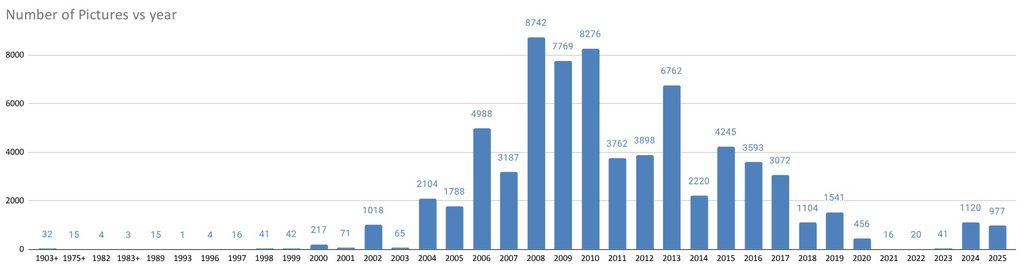
In February another file python/summary_folders/update_folder_summary.py with 122 lines was added. Claude.ai and Gemini and OpenAI ChatGPT provided the support.
Then agentic coding became more popular. I approached this problem again in September:
Agentic coding in September 2026 – no code for 8 hours
I started a conversation with ChatGPT about my requirements of the kreier/bilder repository project. After two hours of audio input from me (my fastest: 150 wpm) and text feedback (also fastest for me – reading 250 wpm) we had some requirements established.
Being home I tried to document our ideas and structures into the relevant files. Eventually we created:
- AGENTS.md – 235 lines
- CHANGELOG.md – 60 lines
- CONTRIBUTIONG.md – 115 lines
- SECURITY.md – 108 lines
- docs/architecture.md – 1356 lines
- docs/configuration.md – 277 lines
- docs/current_plan.md – 85 lines
- docs/data-model.md – 1944 lines
- docs/vision.md – 273 lines
Especially the data-model.md took about 4 hours of conversations with the AI until the first draft was created. Writing software does not start with the actual program, but the project definition an AI agent would understand. Which, in a way, is also a program – actually human-readable instructions and definitions. So we got
4453 lines of Markdown in 8 hours
And it did not stop there. The implementation in python and vite/typescript eventually lead to a conversation about the release of a docker package on ghcr.io in the future and automated update services on the machine running the docker container.
The short conclusion: new tools might speed up bottlenecks, but the time spend on projects might stay constant. The requirements increase, the level of complexity. And it becomes very difficult to go back, it might only happen for education or entertainment.