

Hiện tại đây chỉ là lịch trình tạm thời cho chuyến đi bộ đường dài của chúng tôi vào ngày 11 tháng 10 năm 2026 đến…
Year: 2026
-
AI support in Coding
For almost 4 years since ChatGPT we’re wondering more publicly how AI will change our future. I found the label “tool” appropriate since we can compare how other tools have changed society and human behaviour.
Usually tools let us do things faster. Complex mathematical expressions can be calculated or solved with a calculator or more specific a CAS variant. I remember a challenge in Germany for high school math in the 2010s where a graduation test question in math was designed to require approximately 20 minutes. But a smart student asked if this could not simply be answered with the correct sequence of parameters on his Voyage 200 calculator, demanding only 1 minute? This solution had escaped the designers of the question. The calculator removed a known bottleneck of 20 minutes down to 1 minute, a 20x speed increase. But do graduation tests now finish faster? No, the time for tests stayed approximately the same in the decades of testing. Eventually we split the test in a tool-free and tool-assisted section. The second part has its unique challenges and would require an enourmous amount of time to solve without the tool, become virtually impossible. For this part you rely on the tool.
Another example is the bicycle or car. It let’s us move between destinations much faster. But looking at historic data, the time spent going to work and home has plateaued many decades ago. With a fixed time each day the accessable area for work with our tool (the car) has become so large that it becomes a standard that can’t be accessed without the tool – which changes societies, how cities are build, what jobs are offered, what infrastructure will be designed. A change there will take a very long time, will be very expensive and therefore the reliance on the tool solidifies. You need a car.
Writing code in 2023
I remember asking LLMs to:
Write a “hello world” in Java, Python and Rust.
In my Advanced Automation class at SSIS my students used ChatGPT to write code in JavaScript for the p5.js implementation to improve their machine learning project. In this case it was a neural network for character detection, teaching the model new Spanish characters.
Coding with LLM in 2024 – 42 lines
I have a scattered image collection of more than 100,000 images that I try to organize. It requires a lot of extra efford and time. I used several Excel sheets over the years, and had some folder structure in place. Aspects of provenance, dublication and syncronisation became so time-consuming that I decided to write some python programs to handle this.
On October 11th, 2024 I created the repository https://github.com/kreier/bilder for this task. The
investigate.pyis just 42 lines long, but it creates a few CSV files.One year later, October 14th, 2025 a new structure was proposed. But I had no time to implement it.
Early 2026 – 94 and 122 lines
In January 2026 I added
ds216/update_summary.pywith 94 lines andiCloud/investigate.pywith 37 lines. Now it included a Excel file! And it even created an image: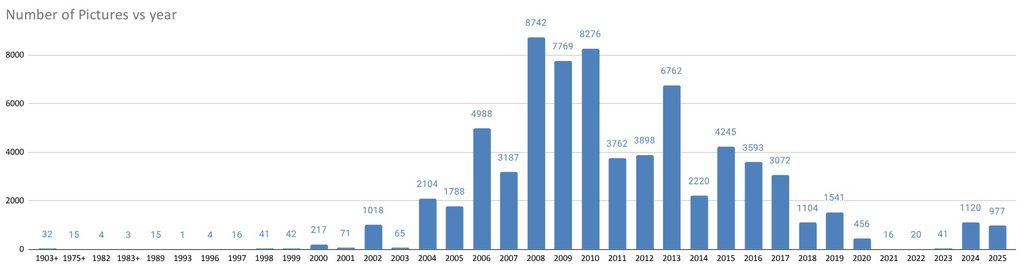
In February another file
python/summary_folders/update_folder_summary.pywith 122 lines was added. Claude.ai and Gemini and OpenAI ChatGPT provided the support.Then agentic coding became more popular. I approached this problem again in September:
Agentic coding in September 2026 – no code for 8 hours
I started a conversation with ChatGPT about my requirements of the
kreier/bilderrepository project. After two hours of audio input from me (my fastest: 150 wpm) and text feedback (also fastest for me – reading 250 wpm) we had some requirements established.Being home I tried to document our ideas and structures into the relevant files. Eventually we created:
- AGENTS.md – 235 lines
- CHANGELOG.md – 60 lines
- CONTRIBUTIONG.md – 115 lines
- SECURITY.md – 108 lines
- docs/architecture.md – 1356 lines
- docs/configuration.md – 277 lines
- docs/current_plan.md – 85 lines
- docs/data-model.md – 1944 lines
- docs/vision.md – 273 lines
Especially the
data-model.mdtook about 4 hours of conversations with the AI until the first draft was created. Writing software does not start with the actual program, but the project definition an AI agent would understand. Which, in a way, is also a program – actually human-readable instructions and definitions. So we got4453 lines of Markdown in 8 hours
And it did not stop there. The implementation in python and vite/typescript eventually lead to a conversation about the release of a docker package on ghcr.io in the future and automated update services on the machine running the docker container.
The short conclusion: new tools might speed up bottlenecks, but the time spend on projects might stay constant. The requirements increase, the level of complexity. And it becomes very difficult to go back, it might only happen for education or entertainment.
-
One year later, is the diary ready?
Exactly one year ago I was challenged with a diary that should also include experiences from the age of five. While I certainly lack notes from that early in my childhood, I actually have made some efford to document my life. Can I consolidate all the scattered information from websites, projects, paper copies, photo albums and apps like Instagram?

Statistics:
- Days covered: 660
- Total entries: 1733
- Total words: 470,112
- Total reading time: 39h 11m
The automatic scanning of my project websites is not yet finished. Maybe I should revisit this idea in one year. I hope by then I have the 4 stages defined, a web interface to manage the sources, and respective JSON files for each stage and each source. The idea is there, the implementation needs time.
PKM Personal Knowledge Management
That’s what Obsidian, Notion and Logseq are usully describe tools for. Since I worked with MarkDown since 2018 I decided to use Obsidian. Currently it has already 161 articles with 72,590 words. It would take 4h33 to read. Here is the graph:

And if I highlight one article from this web it looks like:

I’m curious what results I have next year.
-
DUV – VUV – EUV
In recent years the industry related to computers and the internet has become a larger part of the economy and everyday life of humans. The computational parts are found in smartphones, cars, bank terminals, TVs, coffee machines and toasters. The smaller the structure, the more energy efficient it can be, the faster it can compute, the more integrated it can get.
Light sources
The smallest feature size is related to the light source used. One can get beyond the Rayleigh limit with multi-pattern, phase corrected images etc. But eventually one needs a shorter wavelength. The limit of DUV (deep ultra violet 193nm) was long known. Since the 1990s serious investigations have been made to go beyond. Eventually EUV (extreme ultra violet 13.5nm) emerged as the solution, and in 2026 the company ASML is the sole provider of light sources with this wavelength for large scale lithography to produce semiconductors. A “simple machine” costs easily 180,000,000 USD like the TWINSCAN NXE:3300B that first shipped 2013.

And the high-NA rather approach 400 million USD. My AR65 machine 6 years earlier at the Humboldt university in Berlin was not that expensive. Here at BESSY:

But I wondered what wavelength I was using to investigate my CdHgTe crystals. In the early 2000s we labeled our light as VUV (vacuum ultra violet) because for the energy used there is no window material available (6.2 to 124 eV, see my diploma thesis from 2008, page 19). We measured the energy in eV because the energy itself was more important. The conversion is easy:
where:
- (speed of light).
- (Planck’s constant),
With the Bessy Syncrotron I used the beam energy up to 125 eV, the respective wavelength is is actually shorter than the 13.5 nm (92 eV) used by ASML

But for most cases I needed less energy, the lower energy bands were more important for the optical and electronical properties of my narrow-gap semiconductor. Most measurements were actually done with the He I α line at 21.218 eV or 58.43 nm. That is significanly shorter than DUV, the shortest wavelength currently used for lithography in China with the Argon fluoride excimer laser ArF and 193 nm (6.42 eV). With immersion scanners (ArFi) one can achieve a high numerical aperture up to 1.35 and produce chips at nominal 7 nm. A great example of engineering achievements.
Name Source Wavelength Photon energy VUV Syncrotron 9.9 nm 125 eV EUV Sn 13.5 nm 91.8 eV VUV He I α 58.4 nm 21.22 eV DUV ArF 193 nm 6.42 eV -

China Homelife and Machinex 2026
A few weeks earlier I had visited a similar fair for textiles and related products with many suppliers from China. I was impressed that they had shiped entire fabrication machines to the exhibition site to show them in production. What awaits me this time?

Advertisement on the page of the SECC Yes, just wanted to stop by shortly, but then Pickleball was canceled. And there was so much to investigate! It were actually 6 exhibitions in 3 halls:

One thing I was interested was coffee makers, and one machine served free coffee to the visitors – indicated by the long line there. But that’s just one example.

There are also solar panels, MPPT solar chargers, battery blocks (in 2025 the price/kWh has fallen by 40%), inverter (we needed one for Simon in the Phillipines, Malungon)

Some let you have a look inside to be sure of the quality. I made contact on WeChat and got a new supplier for our KH door from Taiwan with production side in northern China.

But there were even stranger supplies. Here a short list:
- AMD graphics card RX580 with 8GB RAM (released 2017 – 9 years ago!!)
- UHF 640-690 MHz dual wireless microphone from Sertong (Guangzhou Sertong Electronics Technology Co., Ltd., est. 2004)
- OEM producer for portable batteries as off-grid power or energy storage for solar, that also provides services to Xiaomi, Haier and BYD
- Robotphoenix with a 4D package robot on display. They also provide educational robots, and send me their catalog (No. 477 Hongxing Road, Xiaoshan Economic Development Zone, Hangzhou, Zhejiang, China)
- Gas separation plant for N, O, Ar and liquid nitrogen
The last one was wild. I did not take a picture of their model from a gas separation plant to produce Nitrogon, Oxygen or Argon. I could even have taken it with me for educational purposes. Back in 2007 I needed liquid nitrogen to cool my Helium lamp to produce VUV (vacuum ultra violet) light, similar to EUV (extreme ultra violet) light used by ASML for lithography. But at the Humboldt university we bought the liquified gas instead of producing it ourselves. How much would it cost to produce it yourself?
Gas separation plant
The main obstacle is actually the energy cost. Main application in China is nitrogen gas. I think it is for food purposes because of its inert nature. Here are the prices:
- Nitrogen 0.2 kWh per cubic meter
- Oxygen 0,5 kWh per cubic meter
- Liquid nitrogen 1.0 kWh per cubic meter
If you don’t need it in liquid form, the gas is 5x cheaper. I forgot the price for Argon (0.9% of our athmosphere) that we used for TIG welding at SSIS. I still remember my early attempts on the 3mm aluminum cube. Good times! Now I’m even more motivated to visit China in summer.
-
5 mountains in 5 days
Looking back the planning and preparation took more than 8 months, at least for Brah Yang, my favorite mountain now. With our university currently having no lesson on Wednesday and two extra holidays on
With no lesson on Wednesday, and given Thursday and Friday are holidays – that’s 5 days to start some hiking adventures! Here are the goals:
- 29.04. Núi Vũng Maý in Vũng Tào – 220 m
- 30.04. Núi Chứa Chan – 837 m
- 01.05. Núi Tà Cú near Phan Thiết- 694 m
- 02.05. Núi Brah Yang – 1879 (1866) m
- 03.05. Núi Thị Vải – 467 m
The start on Wednesday is a little delayed because of a 200M investment to preferred conditions at Vietcombank. It pays to be a “Titan” customer, just hit the limit with AML laws.
Núi Vũng Maý
There are a few mountains in Vũng Tàu, but actually accessible are only a few:
- Nghinh Phong, Núi Nhỏ, 138 m, Wikipedia – Christ of Vũng Tàu, its more about the largest Christian statue across Asia
- Núi Tao Phùng, 176 m, Hải đăng Vũng Tàu (Vung Tao lighthouse) – closed during the night, good view over to the statue of Christ
- Núi Tương Kỳ, 245 m, Núi Lơn, but now has the Du Lịch Hồ Mây with 400k entrance. You can also take the cable care there, some 450k
- Núi Vũng Maý, 220 m, nice round trip on all trails
Núi Chứa Chan
This is the first official visit. I’ve been at the basement already on 2026/03/01 but had no intention to actually go up. And for 2 years already you can’t go to the top – either of them. The whole mountain is a construction zone since 2024. You see the big holes in the forest when coming from the West, from far away. One day you will have 4 car lanes leading to the top.
Núi Tà Cú
Two times the charm. While I only made it to the front gate with Núi Tà Cú, this time at Núi Tà Cú I wanted to reach the top by foot. A little exhausted from the previous day I took way to many breaks, but eventually made it!
Núi Brah Yang
This was worth 8 months of planning. Initially I wanted already stop here on my way to the wedding in Hanoi in October 2025. And it is too far from Saigon for just a day trip. On my way to my third Half-Marathon, this time in Can Tho, in September 2025 I stopped in and talked with Tri Anh’s mother, since she manages a hotel near the mountain. But the plan changed.
Early April 2026 I got 6 consecutive days of, so I thought about combining several mountains. But it was also the time of the memorial, and eventually there was only time for Daytrip to Núi Lang Biang. A new chance appeared at the end of April, and I started the 5 Mountains in 5 days. Brah Yang was number 4!
Núi Thị Vải
I am a little tired after the Núi Brah Yang a day before. And have to be back early in Saigon, so enough time for a short loop.

- Location: Núi Thị Vải and distance: 57.5 km , 1h14
- Details: height 467 meters, round trip about 1h40 for 5.07 km. Needs 913 kcal.
I’ve been there three times, the second time (see Strava with 3D flyover) I finally found the “peak” which is 50 meter below the peak and 200 meters away from it on a rock plateau with a view.

-
The Teochew Food Festival 🥢
Our course is studying the Vietnamese language and culture. Both are strongly influenced by the Chinese neighbor and its language(s) and culture(s). With 4 Chinese students in our group it was fitting to visit the anual Lễ Hội Ẩm Thực Triều Châu (Teochew Food Festival, celebrated from the 16th to the 27th day of the First Lunar Month – March 4 to March 15, 2026) at the Hội Quán Nghĩa An (Nghĩa An Assembly Hall). There is so much to learn about culture and history here!

I could start with the background, since it looks very much like a temple. And a part of this Hội Quán (會館 – community hub) serves as temple, but also as a town hall, a mutual aid society, a commercial network hub, and a place of ancestral worship for immigrants adapting to life in Vietnam.
The specific Chinese group settled here are from Chaozhou (Chinese: 潮州, alternatively Chiuchow, Chaochow or Teochew) in the Teoswa region of east Guangdong, China.
The Food Festival
This festival has it’s own Wikipedia page, but currently only in Vietnamese: Hội quán Nghĩa An. As mentioned above it is held at the end of the first lunar month. It is famous for …

And we tried even more food:

One memorable part is.
Cultural importance
This community hall and the food festival were considered important enough for the Vietnamese culture that it got official recognition and protection. Here is a plate inside the community hall:

The text reads “DI SẢN VĂN HÓA PHI VÂT THỂ QUỐC GIA TẬP QUÁN XÃ HỘI VÀ TÍN NGƯỠNG TẾT NGUYÊN TIÊU CỦA NGƯỜI HOA TP. HCM” which translates to “National Intangible Cultural Heritage: Social Customs and Beliefs of the Lantern Festival (Tết Nguyên Tiêu) of the Chinese Community in Ho Chi Minh City”.
Here is an official list of such recognitions in Vietnam, starting 2012 and now having already 485 entrances: Danh mục Di sản văn hóa phi vật thể quốc gia (List of National Intangible Cultural Heritage).